

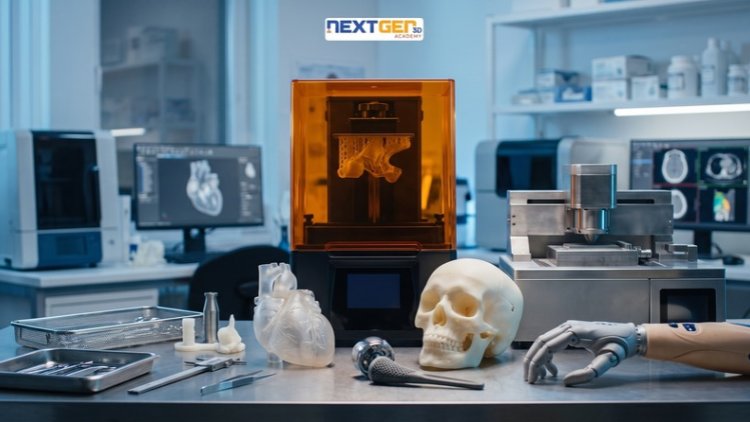
Additive manufacturing is fundamentally transforming modern clinical practice, surgical precision, and regenerative medicine. From patient-specific anatomical models that allow surgeons to rehearse complex neurosurgical and cardiac procedures before making an incision, to porous titanium orthopedic implants that promote natural bone osseointegration, 3D printing has evolved from an industrial prototyping tool into a vital healthcare technology. The Application of 3D Printing Technology in Medical Science Masterclass delivers a comprehensive, interdisciplinary curriculum engineered to equip biomedical engineers, clinicians, dental specialists, medical device developers, and healthcare innovators with end-to-end mastery over medical additive manufacturing workflows.
Structured across six progressive modules and twenty-four detailed lectures, participants explore the complete clinical additive manufacturing pipeline. The curriculum compares core medical printing technologies—including Fused Deposition Modeling (FDM with PEEK and PLA), Stereolithography and Digital Light Processing (SLA/DLP with Class I/IIa biocompatible and autoclavable dental resins), Selective Laser Sintering and Melting (SLS/SLM with PA12 nylon, Ti-6Al-4V titanium, cobalt-chrome, and tantalum), and multi-material PolyJet systems. Learners master the end-to-end medical imaging workflow—converting CT and MRI DICOM datasets into watertight 3D STL meshes through thresholding, region-growing, and AI-assisted segmentation—to produce custom drilling and cutting guides, digital dentistry restorations, bespoke prosthetics and orthotics, and craniofacial reconstructions. Furthermore, the program delves into cellular bioprinting and tissue engineering, examining bioink formulations (GelMA, alginate, collagen, hyaluronic acid), iPSC differentiation, and sacrificial printing strategies to overcome tissue vascularization barriers.
Grounding biomedical theory in real-world clinical and pharmaceutical practice, the masterclass investigates FDA clearance pathways (510(k), PMA, De Novo, HDE), EU Medical Device Regulation (MDR) custom-made device mandates, point-of-care hospital manufacturing quality systems, and patient data privacy ethics. Participants analyze two detailed clinical and scientific case studies: a complex cranial reconstruction utilizing contralateral CT mirror imaging, SLA molds, and compression-molded PEEK-OPTIMA implants verified to ISO 10993 and ISO 17665 standards, and an extrusion-bioprinted human iPSC cardiac tissue platform with perfusable vascular channels validated for pharmaceutical cardiotoxicity screening. Concluding with emerging frontiers in 4D printing, in-situ intraoperative bioprinting, and biomedical career pathways, this program prepares professionals to lead innovation at the intersection of engineering and medicine.