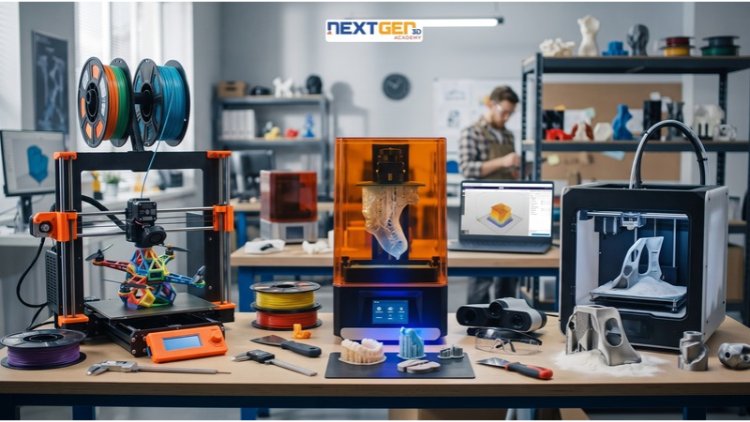

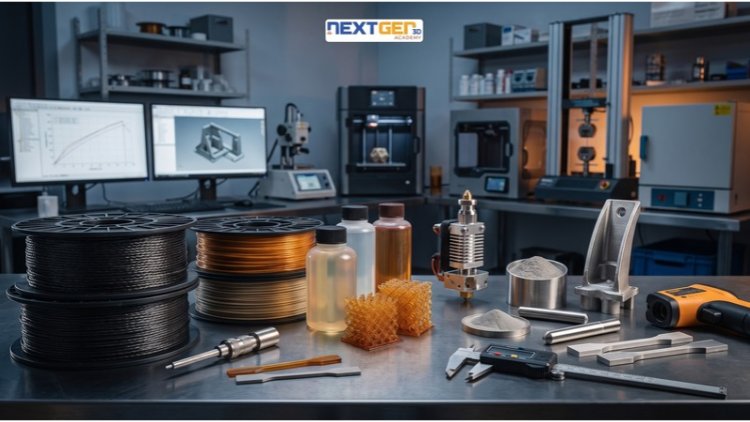
At the core of every successful additive manufacturing application lies materials science—the precise understanding of how polymers, photopolymers, composites, and metals behave under thermal, mechanical, and chemical stress. As the global 3D printing materials market expands past $8 billion, choosing the wrong material or misconfiguring processing parameters remains the primary cause of part failure, warping, and structural delamination. The 3D Printing Materials Science Explained Masterclass delivers an exhaustive, technical curriculum engineered to take makers, product designers, and manufacturing engineers from foundational polymer chemistry to industrial-grade material selection.
Structured across six comprehensive modules and over twenty-five detailed lectures, the curriculum systematically examines mechanical and thermal characterization metrics—including tensile strength, Young's elastic modulus, elongation at break, Izod/Charpy impact strength, Glass Transition Temperature (Tg), Melting Temperature (Tm), and Heat Deflection Temperature (HDT). Participants master processing parameters, moisture management, and post-processing across standard thermoplastics (PLA, ABS, PETG, Nylon 6/12, flexible TPU) and ultra-high-performance engineering polymers (Polycarbonate, UV-resistant ASA, and 400°C aerospace-grade PEEK and PEI/Ultem). The course further covers SLA/DLP photopolymer curing kinetics (standard, tough, flexible, castable, and biocompatible dental resins), two-stage IPA washing and UV post-curing, chopped carbon-fiber and glass-fiber composites, and metal-filled filament debinding and furnace sintering.
Synthesizing materials engineering with commercial execution, the masterclass equips learners with structured weighted-scoring selection matrices, total cost of ownership (TCO) per-part economics, and supplier qualification protocols. Participants analyze two detailed industry case studies: selecting FAA FAR 25.853 flame-smoke-toxicity compliant PEI (Ultem 9085) over PA12 and PPSU to achieve a 42% weight reduction in aerospace interior ducting, and validating ISO 10993 biocompatible, autoclave-sterilizable SLA surgical guide resins to enable 48-hour rapid prototyping cycles for an orthopedic medical device startup. Concluding with materials lab setup and standardized test-print calibration workflows, this program empowers professionals to engineer reliable, high-performance 3D printed parts for any demanding environment.