
- What is the meaning of tenses?
- What are the three broad categories of tenses?
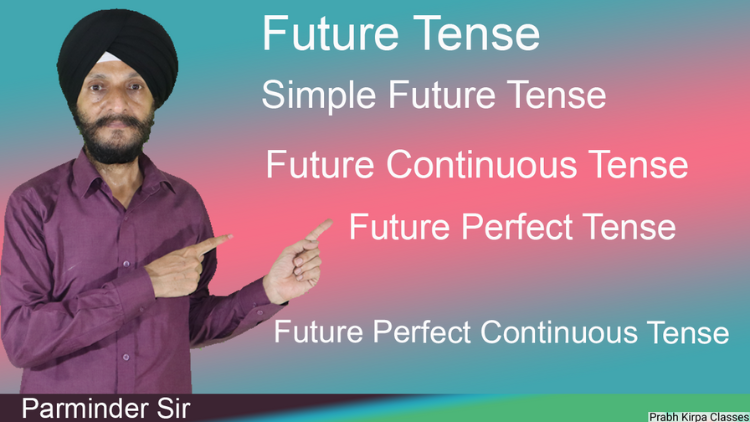
- We will also discuss in detail all the four different types of Future tense:
Future Tense
FUTURE TENSE
All Levels • 5 Lectures • Full Lifetime Access
Verified Master Instructor
TRAILER
Meet your instructor: Prabh Kirpa Classes
19 ms
5.0 / 5.0
Global Rating1
Active StudentsEnglish (US)
99 Languages Subtitles1h 39m
Total ContentWhat you will learn
Simple Future Tense
Future Continuous Tense
Future Perfect Tense
Future Perfect Continuous Tense
Course Content
5 sections • 5 lectures • 01:39:05 total lengthSimple Future Tense
26:40
When to use future simple tense?
Formation of positive, negative and interrogative sentence in simple future tense.
Contractions and answers in simple future tense
Common Mistakes made in simple future tense
Practice
Future Continuous Tense
28:55
When we use future continuous tense?
Formation of positive, negative and interrogative sentence in future continuous tense.
Contractions in future continuous tense
Adding – ing to verb
When not to use future continuous tense
What are action verbs and stative verbs?
Common mistakes made in future continuous tense & Practice
Weekly Study Plan
Plan Your Learning Journey
AI generates a personalized schedule based on your availability5 hrs/week
Requirements
Keine
Target Audience
Students who are interested in learning Future Tense and its types
About this course
In diesem Kurs werden wir besprechen –
Zeitformen spielen eine entscheidende Rolle in der englischen Sprache. Sie bezeichnen den Zeitpunkt, zu dem eine Handlung stattfindet, sei es irgendwann in der Vergangenheit, in der Gegenwart oder zu einem bestimmten Zeitpunkt in der Zukunft. Zeitformen sind einfach die Art und Weise, wie wir über Zeit sprechen. Zeitformen lassen sich grob in drei Kategorien einteilen - Vergangenheit, Gegenwart und Zukunft.
In jeder Kategorie der Zeitform gibt es vier verschiedene Typen, nämlich:
Wir werden auch alle vier verschiedenen Arten der Zukunftsform im Detail besprechen:
i) Future Simple Tense
ii) Future Continuous Tense
iii) Future Perfect Tense
iv) Future Perfect Continuous Tense
Die Future Simple Tense wird verwendet, um über eine Handlung zu sprechen, die in der Zukunft stattfinden wird. Diese Zeitform wird auch verwendet, um einen Wunsch oder einen Plan auszudrücken oder Ereignisse vorherzusagen, die in der Zukunft stattfinden sollen. Sie wird auch für Versprechen/Anfragen/Ablehnung/Angebote verwendet.
Future Continuous Tense ist auch als Future Progressive Tense bekannt.
Future Perfect Tense wird verwendet, um auf
Future Perfect Continuous Tense ist eine Zeitform, die verwendet wird, um über eine Handlung zu sprechen, die für einen bestimmten Zeitraum in der Zukunft andauern wird. Future Perfect Continuous Tense wird auch verwendet, um Handlungen zu beschreiben oder anzuzeigen, die in der Vergangenheit begonnen haben und bis zu einem bestimmten Zeitpunkt in der Zukunft andauern werden.
Meet your instructor
Prabh Kirpa Classes
Main Instructor
Educator
This channel is purely education based. Our aim is to ensure that the students are able to understand each and every question in an easy way. We take pride in providing quality educational services to the students of Class VII to Class XI Science NCERT, English, Computer solutions, Mathematics, Business Studies & Economics. Our goal is to help the leaders of tomorrow to learn to succeed today....
More Courses by
Prabh Kirpa ClassesStudents also bought
Learners who viewed this course also enrolled in these top-rated courses
Teaching & Academics | Engineering
Unlock the world of 3D printing and product creation with a hands-on, industry-focused course designed to turn your ideas into reality. Whether you’re an engineer, designer, technician Masterclass.
5.0
3h
19 lectures
Intermediate
$12.99

Teaching & Academics | Math
Taking Your Mastery of Probability to the Next Level
5.0
1h 30m
6 lectures
All
$9.99
$19.99
Teaching & Academics | Math
Advanced Formulas and Strategies for Cone Surface Area Determination
5.0
1h
10 lectures
All
$19.99
FREE

Teaching & Academics | Current Affairs
Master all important Current Affairs from June 1–30, 2026 with daily video lectures, MCQs, exam-oriented explanations an
5.0
8h 30m
29 lectures
Beginner
$29.99
$39.99
Teaching & Academics | Math
Unlocking the Power of Bar Charts for Effective Data Communication
5.0
1h
5 lectures
All
$14.99
$19.99
Frequently Asked Questions
Find answers to the most common questions about this course.
Yes! Upon completing 100% of the course lectures and assignments, you can instantly download your verified digital Certificate of Completion directly from your Lucebra profile.
Explore More in Technology
Expand your learning journey with accredited certificates, related digital books, and live interactive classes.