
Prompt engineering is the skill of designing clear, structured, and purposeful instructions that help generative AI systems produce more accurate, relevant, and useful results. This course provides a practical and tool-agnostic introduction to prompt engineering, allowing learners to apply the same core principles across different AI platforms without depending on one specific product.
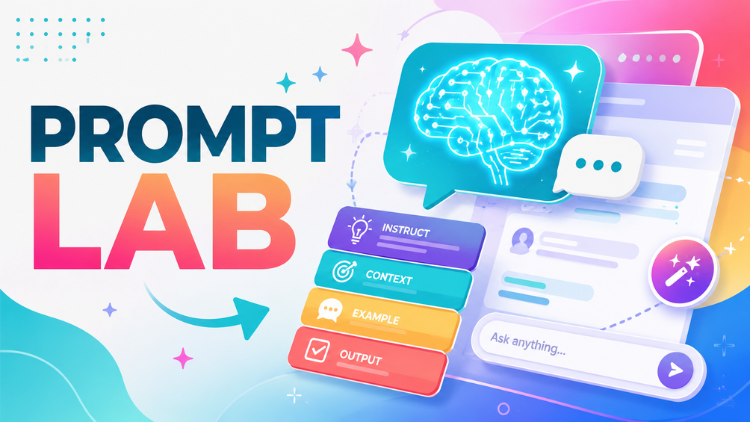
The course begins with the fundamentals of effective prompts. Learners will understand how clarity, context, role definition, constraints, examples, output format, and audience influence the quality of AI-generated responses. They will also examine common reasons prompts fail, including vague instructions, missing context, conflicting requirements, and unrealistic expectations.
Learners will then follow a step-by-step process for crafting stronger prompts. This includes defining the objective, providing relevant background information, specifying the required task, setting boundaries, requesting a suitable output structure, and reviewing the result. The course shows how small changes in wording and structure can significantly improve response quality.
Advanced prompt techniques are introduced to help learners handle more complex tasks. These techniques include role prompting, iterative prompting, prompt chaining, multi-step instructions, example-based prompting, comparison prompts, evaluation prompts, and structured output requests. Learners will discover how to divide complex objectives into manageable stages and guide AI systems through a more reliable reasoning and production process.
The course also explores prompt engineering across a range of practical use cases. Learners will see how prompts can support professional writing, content development, summarization, brainstorming, research, planning, customer communication, learning, data interpretation, problem-solving, and basic technical tasks. The focus remains on transferable strategies that can be adapted to different industries and responsibilities.
Prompt engineering best practices are covered to improve consistency, accuracy, and efficiency. Learners will understand how to test alternative prompt versions, identify weaknesses in AI responses, request revisions, verify important information, reduce ambiguity, and create reusable prompt templates. The course also emphasizes the importance of human review when AI outputs may affect decisions, customers, or published materials.
A dedicated section explains tool-agnostic prompt strategies. Learners will discover how to write prompts that remain effective across different generative AI platforms, even when tools vary in their interfaces, capabilities, or response styles. They will learn how to preserve the core structure of a prompt while making practical adjustments for different systems and use cases.
The course also addresses responsible AI use, including privacy, bias, accuracy, transparency, and the risks of sharing sensitive information. By the end of the course, learners will be able to design, test, refine, and reuse effective prompts for a wide variety of personal, academic, and professional tasks.