

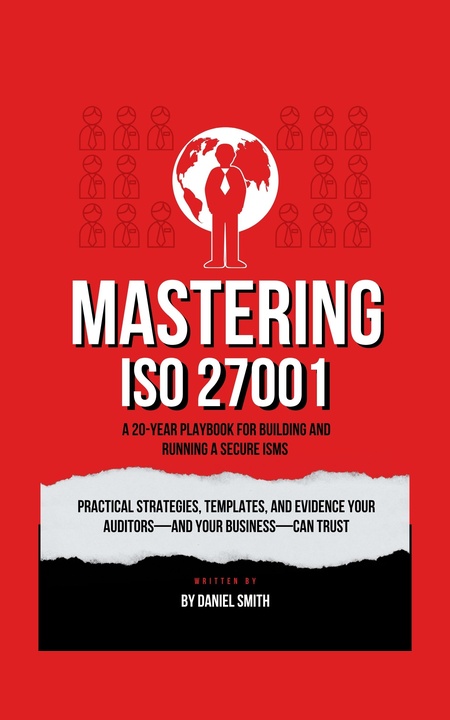
Mastering ISO 27001: A 20-Year Playbook for Building and Running a Secure ISMS is a practical guide for professionals and organizations that want to turn information security from isolated controls into a structured, governable, measurable, and continually improving management system.
Written by Daniel Smith, the book emphasizes that the real value of ISO 27001 is not simply the certificate. Its value comes from the management system that identifies important information, evaluates risks, selects appropriate controls, assigns clear ownership, generates evidence, measures performance, corrects weaknesses, and continually improves security outcomes.
The book begins by explaining why ISO 27001 remains important after more than two decades. It traces the evolution of the standard from 2005 through 2013 to the 2022 edition, showing how ISO 27001 has adapted to cloud environments, supplier dependencies, identity-based security, threat intelligence, modern development practices, and integrated management systems.
Readers learn how an effective ISMS protects the three fundamental properties of information:
Confidentiality – ensuring sensitive information is only available to authorized users.
Integrity – ensuring information and systems remain accurate, complete, trustworthy, and protected from unauthorized changes.
Availability – ensuring systems, information, and services remain accessible when needed.
The book explains ISO 27001 Clauses 4–10 in plain language, covering organizational context, interested parties, ISMS scope, leadership, responsibilities, risk assessment, risk treatment, information-security objectives, competence, awareness, communication, documented information, operational controls, performance evaluation, internal auditing, management review, corrective actions, and continual improvement.
A major practical component is the inclusion of working templates and registers such as:
Context and Issues Register
Interested Parties and Expectations Register
ISMS Scope Statement
Leadership Commitment Log
Roles and Accountability Matrix
Information Security Policy Approval Record
Risk Assessment Tracker
Objectives Register
Competence Matrix
Communication Plan
Awareness Programme Tracker
Document Control Log
Control Operation Plan
Change and Release Gate
Operations Evidence Tracker
KPI Register
Audit Plan and Results
Management Review Actions
Nonconformity and Corrective Action Log
Improvement Pipeline
The book then explains Annex A, emphasizing that its 93 controls should not be treated as a checklist. Instead, controls are selected and justified based on organizational risks.
The controls are grouped into four areas:
Organizational Controls
People Controls
Physical Controls
Technological Controls
The Statement of Applicability (SoA) is treated as a living operational map connecting risks, controls, owners, evidence, suppliers, cloud responsibilities, exclusions, and compensating controls.
Practical technological topics include identity and access management, MFA, least privilege, encryption, secrets management, secure configuration, patch management, logging, monitoring, vulnerability management, backup, restore testing, and recovery objectives.
The book also provides practical risk-to-control examples for:
Stolen credentials
Ransomware
Sensitive-data exfiltration
Supplier outages and compromise
The chapter Running ISO 27001 in Real Life moves beyond theory into practical governance and daily operations. It covers ISMS steering meetings, operational reviews, risk and SoA reviews, decision logs, action trackers, operating calendars, escalation paths, incident handling, supplier management, third-party security, change control, employee behavior, awareness, and competence.
Incident management is explained from initial reporting through classification, evidence preservation, containment, eradication, recovery, communications, post-incident review, corrective action, and effectiveness verification.
Supplier and third-party risk management includes supplier classification, security due diligence, contract requirements, supplier access, security evidence, remediation tracking, service monitoring, and exit and data-return planning.
The change-management section explains how to protect confidentiality, integrity, and availability during normal, standard, and emergency changes. It covers CI/CD pipelines, Infrastructure as Code, feature flags, rollback plans, vulnerability scanning, monitoring, approval controls, evidence capture, and supplier changes.
The book also explains how organizations can create meaningful security KPIs. Examples include restore success against RTO/RPO, change success rate, access-review completion, vulnerability-remediation timelines, incident containment time, corrective-action closure, supplier assurance, and training effectiveness.
The final chapter focuses on maturity, certification, and continual improvement. It explains Stage 1 and Stage 2 certification audits, surveillance audits, recertification, certification-body selection, audit evidence, readiness checks, common implementation mistakes, and long-term ISMS governance.
A particularly strong section explains how to build and maintain a living Statement of Applicability, including control ownership, evidence links, supplier-backed controls, cloud shared-responsibility models, exclusions, compensating controls, legal traceability, and SoA change workflows.
The book concludes by showing how an ISMS should be scaled differently for startups, mid-sized organizations, and large enterprises while keeping risk criteria, ownership, evidence, and improvement consistent.
Mastering ISO 27001 is designed to help readers build an ISMS that is practical to operate, persuasive to auditors and customers, and resilient enough to adapt to changing technology, threats, regulations, and business needs.