

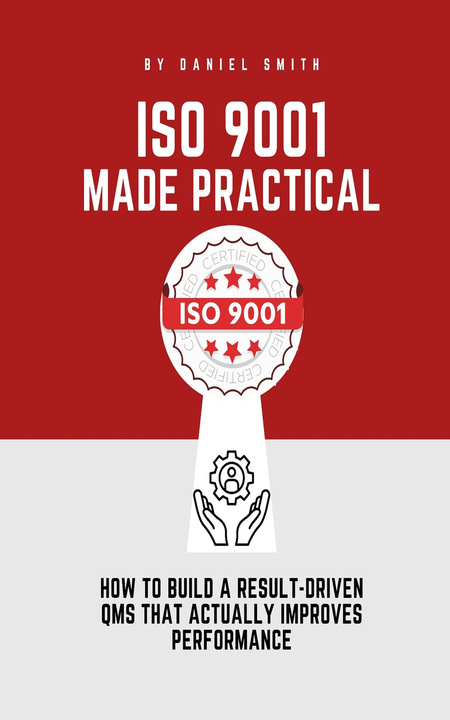
ISO 9001 Made Practical: How to Build a Result-Driven QMS That Actually Improves Performance is a practical guide for professionals and organizations that want ISO 9001 to deliver measurable business results—not simply produce documents for certification.
Written by Daniel Smith, the book transforms ISO 9001 from a compliance framework into a practical operating system for improving quality, reducing variation, strengthening process control, lowering the Cost of Poor Quality, and building reliable evidence for internal and external audits.
The book begins by explaining the global business value of ISO 9001. Organizations everywhere face the challenge of delivering consistent outcomes while customer expectations, suppliers, regulations, product mixes, technologies, and workloads continually change. ISO 9001 provides a common management framework for planning work, controlling processes, verifying results, and continually improving the system.
Rather than treating ISO 9001 as paperwork, the book presents the QMS as a governance and performance system. Leadership establishes measurable quality objectives, processes are designed to achieve them, resources and competence are verified, performance is monitored, and corrective action removes causes instead of merely treating symptoms.
Readers learn how to apply the Plan-Do-Check-Act cycle beyond textbook theory. The book shows how to define measurable targets, embed controls into normal workflows, monitor results using stable KPI definitions, and take corrective action only when evidence demonstrates that the system has actually improved.
A major focus is the Cost of Poor Quality (COPQ). The book explains how rework, scrap, customer credits, expedited freight, downtime, extra inspections, complaint handling, and lost capacity affect financial performance. It shows how ISO 9001 controls can reduce these costs through stronger contract review, supplier assurance, standard work, capability monitoring, and effective CAPA.
The book also distinguishes strategic risk from operational risk and shows how risk-based thinking connects executive decisions with day-to-day process controls. Strategic risks such as new markets, regulations, suppliers, technologies, and product launches are linked to operational controls, KPIs, risk registers, and audit priorities.
Chapter Two provides a step-by-step method for building the QMS structure. Readers learn how to create a lean QMS architecture using process maps, process owners, procedures, SOPs, work instructions, evidence registers, SIPOC diagrams, control points, handoff contracts, and live system records.
The book strongly emphasizes keeping documentation lean, practical, version-controlled, and connected to real evidence. Procedures and SOPs should be written for the people performing the work—not simply for auditors. Each important step should identify acceptance criteria and where the resulting evidence can be found.
The ISO 9001 requirements are then explained pragmatically through Clauses 4–10:
Clause 4 – Context of the Organization
Clause 5 – Leadership
Clause 6 – Planning
Clause 7 – Support
Clause 8 – Operation
Clause 9 – Performance Evaluation
Clause 10 – Improvement
Instead of repeating standard language, the book explains the business meaning, purpose, expected practices, controls, and evidence associated with each clause.
Readers learn what auditors actually check. The book explains that auditors normally test three dimensions:
Existence – whether the control is properly designed.
Operation – whether the control actually runs at the required cadence.
Effectiveness – whether measurable results demonstrate that the control works.
The manuscript provides extensive audit-readiness guidance, including common audit failures, evidence indexes, sample audit threads, competence checks, KPI integrity tests, traceability checks, CAPA evidence, and pre-audit self-checks.
Chapter Four focuses on QMS improvement tools, KPI design, and data culture. Readers learn how to create three complementary types of KPI:
Numerical KPIs that measure outcomes
Control KPIs that confirm discipline and control execution
Predictive KPIs that provide early warning
The book explains how to define stable KPI formulas, identify data sources, establish target/warn/action thresholds, assign owners, maintain query IDs, protect measurement integrity, and define holding periods before improvement actions are closed.
It also provides practical guidance for connecting:
Strategy → Process → KPI → Decision → Improvement
The book explains how to build dashboards that operators can act on and executives can use for management decisions while maintaining reproducible evidence for auditors.
A major practical section addresses Root Cause Analysis and CAPA. Readers learn how and when to use:
5 Whys
Ishikawa/Fishbone Analysis
Process Mapping
SIPOC Analysis
Change Analysis
Pareto Analysis
Measurement System Analysis
Fault Tree Analysis
Event Tree Analysis
Design of Experiments
Control Charts
Process Capability Analysis
The book then shows how to write an effective CAPA from problem statement through verified root cause, containment, corrective change, effectiveness criteria, ownership, holding period, and standardization.
The final chapter concentrates on Internal Audit, Nonconformities & Certification Success.
Readers learn how to design a risk-based annual internal-audit program, create professional audit checklists, conduct interviews, select samples, gather live evidence, write defensible findings, classify major and minor nonconformities, establish closure criteria, and prepare for Stage 1 and Stage 2 certification audits.
The book provides a detailed 8-part nonconformity structure covering requirement, objective evidence, nonconformity statement, extent and sampling, risk/impact, clause and process linkage, containment, and effectiveness-based closure.
Ultimately, ISO 9001 Made Practical shows organizations how to create a QMS that produces its own evidence during everyday work. The goal is not merely to pass certification audits, but to develop stronger processes, better customer outcomes, lower quality costs, reliable data, faster corrective action, and sustainable business performance.