

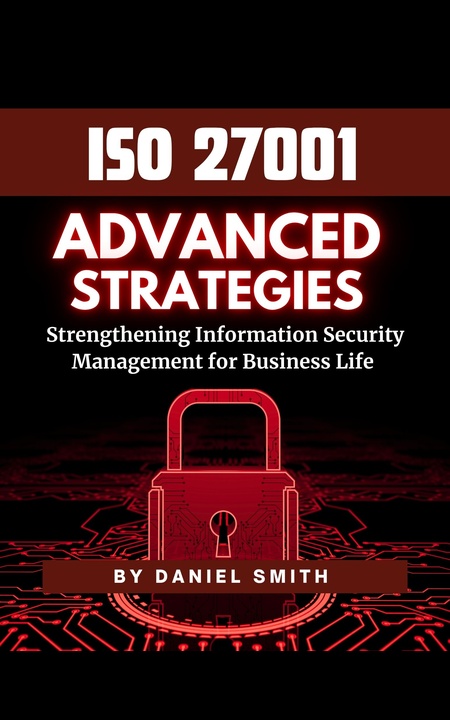
ISO 27001:2013 Advanced Strategies: Strengthening Information Security Management for Business Life is a practical advanced guide for organizations and professionals seeking to strengthen an Information Security Management System and make information security a long-term strategic part of business operations.
Written by Daniel Smith, the book moves beyond basic ISMS implementation and focuses on the advanced strategies required to keep information security effective, adaptable, compliant, and aligned with organizational growth.
The book begins by explaining what distinguishes ISO 27001:2013 from more basic approaches to information security. Rather than treating security as a collection of isolated technical controls, it presents the ISMS as a structured management framework integrating risk-based decision-making, leadership involvement, business objectives, monitoring, internal audits, management reviews, and continual improvement.
Readers learn how information security can be integrated into business strategy rather than treated as a separate IT activity. The book explains how security measures should support organizational growth, customer confidence, regulatory compliance, innovation, operational efficiency, and long-term resilience.
A major theme is continuous improvement and security governance. The book shows how organizations can use audits, incident reviews, management reviews, performance metrics, employee feedback, corrective actions, and preventive measures to continually refine their ISMS.
The chart on page 12 illustrates continuous improvement as a cycle of organizational change, emerging risks, resilience, challenges, and adaptation.
The second chapter focuses on aligning information security with business strategy. Readers learn how to understand business objectives, adopt a risk-based approach, integrate security into strategic planning, align security KPIs with business metrics, involve leadership, encourage cross-department collaboration, develop a security-conscious culture, and demonstrate the business value of security investments.
The graph on page 20 demonstrates the relationship between risk identification, risk assessment, business impact, prioritization, and mitigation.
The book also includes a business case study showing how a growing technology organization integrated ISO 27001 into its strategy, strengthened encryption and MFA, supported regulatory compliance, embedded security across departments, and used continuous improvement to scale securely.
Chapter Three addresses advanced risk management and shows organizations how to move beyond reactive cybersecurity practices.
Readers learn about:
Predictive risk identification
Threat intelligence
Predictive analytics
Machine learning
Risk forecasting
Scenario planning
Proactive risk mitigation
Continuous monitoring
Adaptive risk management
Cyber insurance
Risk transfer
Vulnerability management
Security Information and Event Management systems
The chart on page 41 highlights the book's practical approach to predictive risk assessments, risk forecasting, scenario planning, and long-term risk reduction.
The book explains how historical security incidents, network traffic, threat-intelligence feeds, vulnerability information, and predictive analytics can be used to anticipate ransomware, phishing, fraud, DDoS attacks, data breaches, and other potential threats.
A dedicated Risk Forecasting and Treatment Plan section shows readers how to document predicted risks, evaluate likelihood and impact, define treatment objectives, select controls, assign responsibilities, set implementation timelines, and monitor effectiveness.
Chapter Four focuses on supply-chain and third-party risk management. It explains how risks introduced by suppliers, contractors, service providers, subcontractors, and other external parties can affect an organization's overall information-security posture.
Readers learn how to conduct supplier risk assessments, perform due diligence, define contractual security obligations, create Service Level Agreements, establish audit rights, monitor supplier performance, include third parties in security awareness activities, and develop coordinated incident-response procedures.
The chart on page 55 visualizes extended supply-chain risks, including supplier, logistics, inventory-management, regulatory, and market risks.
Chapter Five examines continuous improvement and innovation for long-term ISMS success. The book explains the Plan-Do-Check-Act cycle, Kaizen, Agile security practices, security innovation, employee education, vulnerability assessments, penetration testing, SIEM monitoring, incident-response testing, and feedback loops.
The PDCA visualization on page 65 demonstrates the four-stage Plan – Do – Check – Act improvement cycle.
The book also introduces a Continuous Improvement Tracker Template for documenting improvement initiatives, objectives, status, timelines, impact assessments, and next steps.
The final chapter focuses on audit and compliance success. Readers learn how to prepare for internal and external audits, define audit scope, collect documentation, conduct interviews, review controls, organize evidence, manage nonconformities, establish corrective-action plans, maintain compliance readiness, and use audit findings to improve the ISMS.
Rather than presenting audits as simple compliance exercises, the book emphasizes using audit feedback as a continuous-improvement mechanism.
Overall, ISO 27001:2013 Advanced Strategies is designed to help readers build an ISMS that remains aligned with business strategy, anticipates future risks, manages third-party vulnerabilities, supports growth, withstands audits, and continually evolves as technologies and threats change.